
How to Never Miss a Contract Renewal Again: A Practical 5-Step System
Missed renewals and surprise auto-renewals quietly drain budgets every year. Here's a simple system any team can follow to stay ahead.
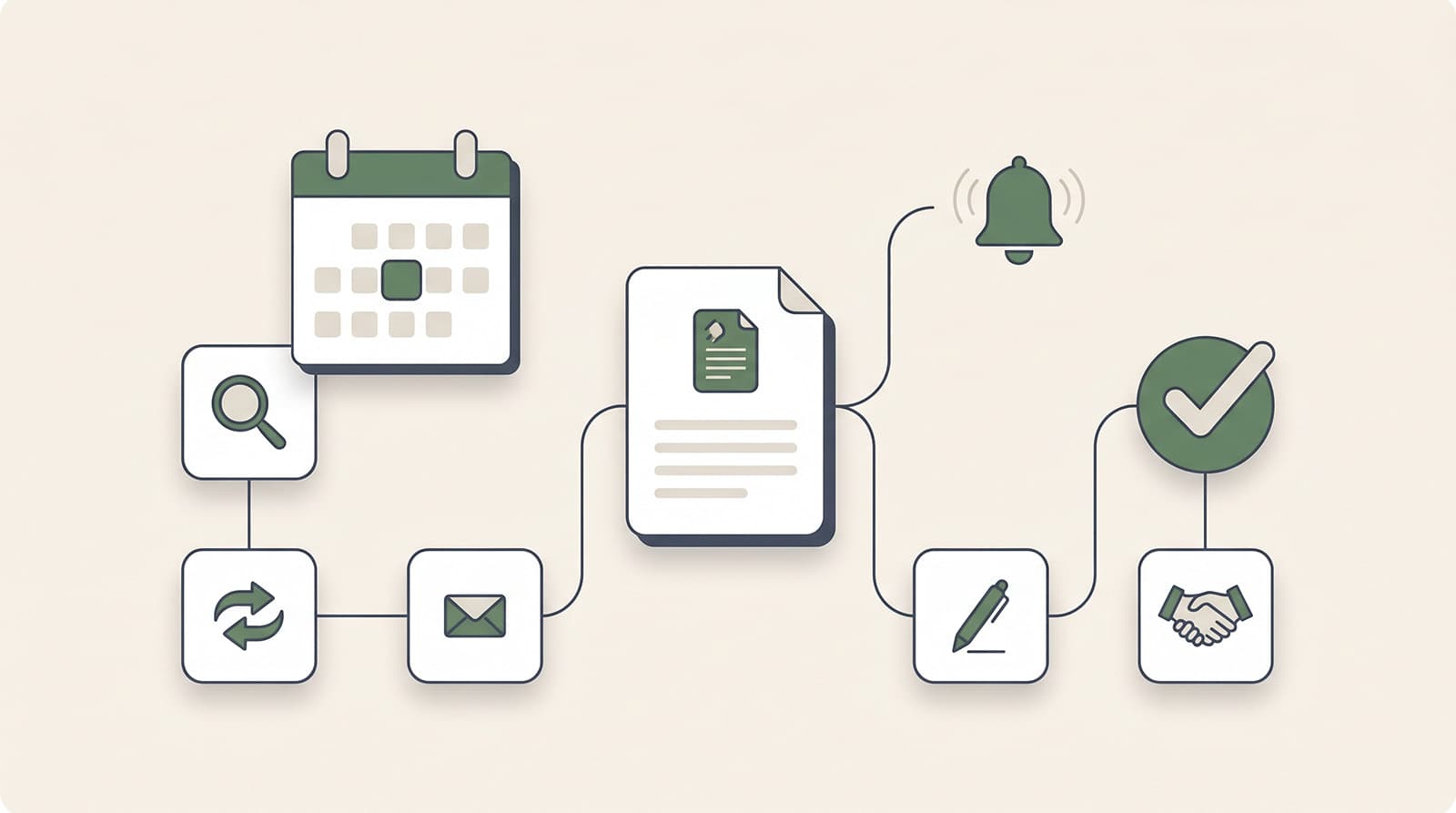
Most businesses do not lose money on contract renewals because they were careless. They lose money because no one owns the process. Vendor contracts arrive through email, get filed on someone's desktop, and are only looked at again when a charge shows up months later.
The good news is that a reliable renewal tracking system does not need to be complicated. It needs five things: a central list, the right dates, timely reminders, clear ownership, and a recurring review. This guide walks through each step so you can build a process your team will actually keep using.
Why contract renewals get missed
Three things usually cause missed renewals:
- Contracts are scattered. Agreements live in email threads, cloud drives, and personal folders. Finding them when you need them is nearly impossible.
- Deadlines are invisible. Even if you know the contract exists, the notice period buried on page 14 of the PDF is easy to forget.
- No one owns it. Without a clear owner, renewals fall into a gap between finance, operations, and whoever originally signed.
Fix these three and most of the pain goes away.
Step 1: Gather every contract you can find
Before you can track renewals, you need to know what you have. Block off ninety minutes and do a sweep across the places your agreements tend to live:
- Email (search for "agreement," "contract," "renewal," "subscription")
- Shared drives and cloud storage
- Accounting or expense tools where recurring charges show up
- Company credit card statements for the last twelve months
You are looking for two things: active contracts you signed, and recurring charges you cannot immediately identify. That second category is where the surprises live.
Step 2: Capture the key dates
For every contract, record three dates:
- Start date
- End date or next renewal date
- Cancellation deadline (the date by which you must notify the vendor if you do not want to renew)
That last one is the most important and the most commonly missed. Many vendors require thirty, sixty, or even ninety days of advance notice. If you miss that window, the contract auto-renews whether you want it to or not.
Also capture the annual cost and the vendor contact. You will need both when it is time to renegotiate.
Step 3: Set reminders before the cancellation window
Putting the renewal date on a calendar is not enough. By the time the date hits, it is already too late to cancel cleanly.
Set reminders so they fire before the cancellation deadline:
- 60 days out: Review whether the service is still worth it
- 30 days out: Start the renegotiation or cancellation conversation
- 7 days out: Final check before action is required
If you are using email reminders, make sure they go to a group or shared inbox, not one person who might be on vacation when the alert fires.
Step 4: Assign an owner for every renewal
Every contract needs one name attached to it. Not a team. Not a department. One person who is responsible for deciding whether to renew, renegotiate, or cancel when the reminder fires.
Without this, renewals sit in everyone's inbox and nobody's plate. With it, there is a clear decision point and a clear decision maker.
If ownership changes (someone leaves, shifts roles, or hands off), update the record the same day.
Step 5: Review quarterly
Schedule a recurring quarterly review of your full contract list. In that meeting, ask three questions:
- What is renewing in the next ninety days?
- What are we paying for that we no longer use?
- What did we miss that we should catch next time?
This is where real savings come from. Most businesses find at least a few contracts they can renegotiate or cancel every quarter, once they actually look.
When to move beyond spreadsheets
A spreadsheet will carry you through the first ten or twenty contracts. Past that, the friction starts to add up. Reminders have to be set manually in calendar or reminder tools. Ownership changes get missed. The spreadsheet goes out of date between reviews, and the next time someone opens it they cannot trust what they see.
That is the point where dedicated contract tracking software starts to earn its cost. A tool like TermUp automates the reminder piece, keeps the document attached to the record, and gives every contract a clear owner without manual upkeep.
Whether you stay on spreadsheets or graduate to software, the five steps are the same. What changes is how much of the work is done for you.
The takeaway
Missed renewals are a process problem, not a discipline problem. Build a simple system around these five steps (gather, capture, remind, assign, review) and you will stop losing money on contracts you no longer want.
Ready to stop tracking renewals by hand? Start a 14-day free trial of TermUp and centralize your contracts, reminders, and ownership in one place.
Ready to put this into practice?
Track every contract, renewal date, and cancellation window in one place with TermUp. 14-day free trial, no credit card required.
Start your free trialKeep reading
Spreadsheets vs. Contract Tracking Software: When to Switch
Spreadsheets work fine at first, until they don't. Here's how to know when your contract tracking needs more than a Google Sheet.
Read articleThe Hidden Cost of Auto-Renewing Contracts (And How to Stop Paying It)
Auto-renewals are designed to be easy to forget. Here's how they quietly drain budgets and a practical playbook for catching them before they fire.
Read article